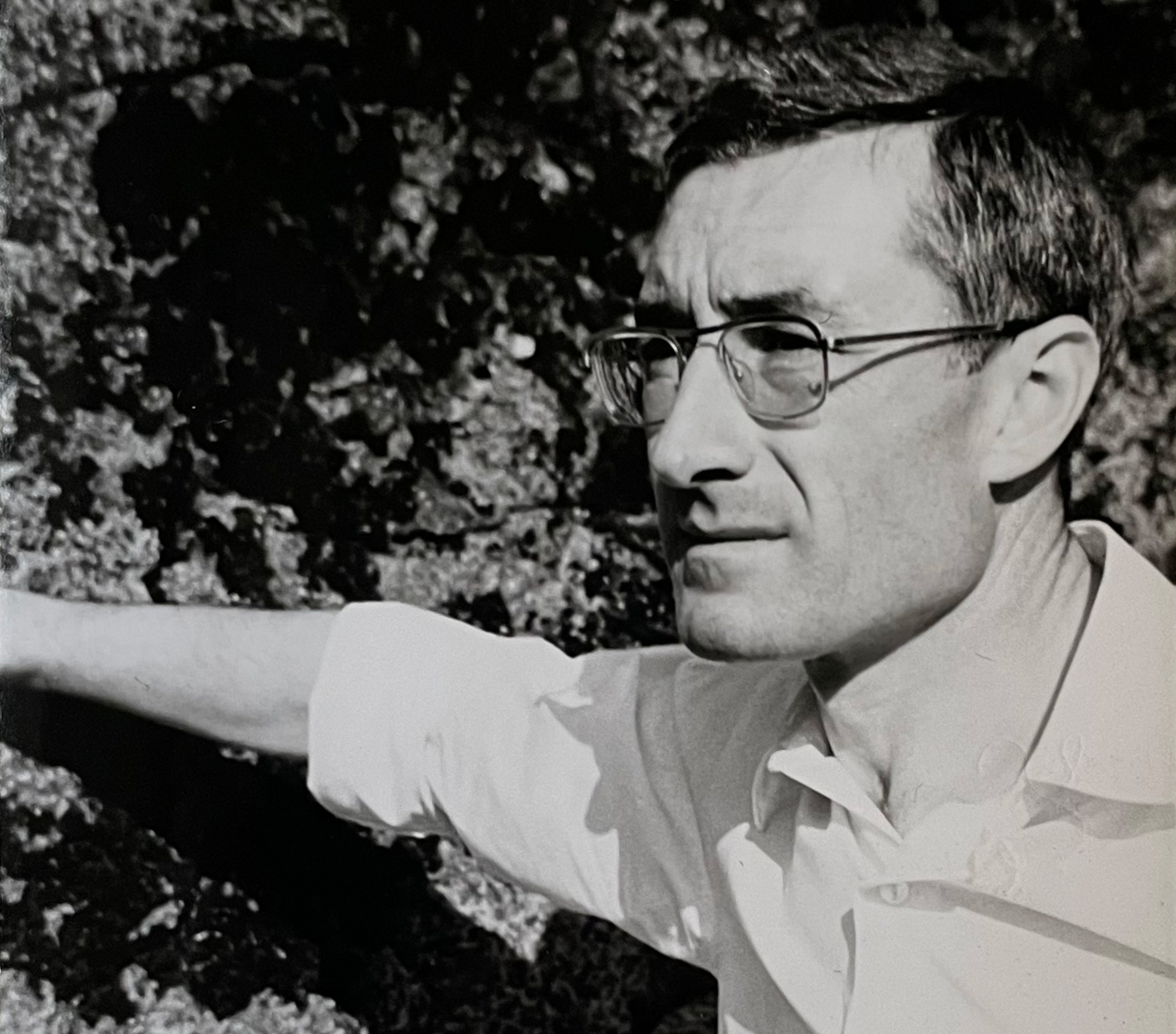
INTERVIEW WITH ROGER FATUS
Conducted by Lucile Montagne and Thomas Hochet on November 6, 2023
This extended conversation between Heritage Curator of Contemporary Collections, Mobilier National, Lucile Montagne and Head of Research and Production for Exhibitions at the Centre Pompidou, Thomas Hochet with Roger Fatus offers a rare, first-person account of postwar French interior architecture. Through the lens of his commission for the Mobilier National, Fatus reflects on material experimentation, institutional culture, exhibition circuits, and the shifting status of design from public service to collectible art.
LUCILE MONTAGNE
In what context did you receive a commission from the Mobilier national?
ROGER FATUS
I was not the one who approached the Mobilier national, which I barely knew; I had no idea what was done there. It was Jean Coural who first suggested calling upon my generation for the furnishing of the new préfectures. He
gathered us at the Mobilier national to explain what he wanted; then the institution selected the objects to be created and the professionals to carry them out.
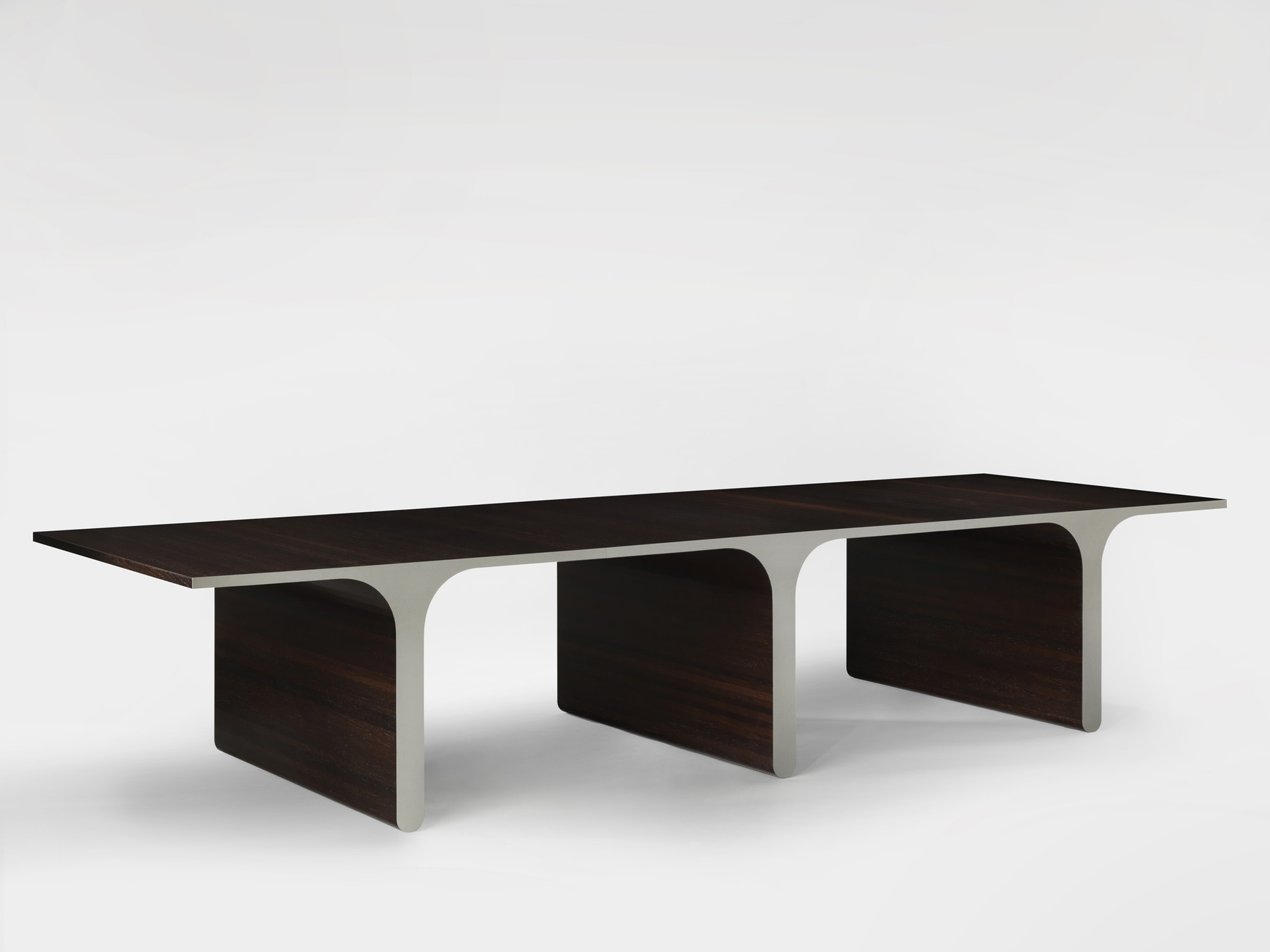
We divided the project among ourselves, and Jean Coural suggested that I take care of the conference-room furniture, which I accepted. I designed a table, as the symbolic element of any conference.
My training at the École nationale supérieure des Arts Décoratifs was in interior architecture, like Joseph-André Motte, Alain Richard, Pierre Guariche, René-Jean Caillette… They were all interior architects, and the word architecture is extremely important.
Some years ago, when people suggested replacing interior architecture with design, we disagreed. Because it did not mean the same thing: creating a pen or a saucepan and redoing the President of the Republic’s apartments
are not the same activity.
THOMAS HOCHET
You joined the ARC at its beginning, three years after it was founded. What did the Mobilier national represent for you at that time?
ROGER FATUS
In terms of modernism and minimalism, the Mobilier national did not set the tone, let’s be honest. I think I am part of a generation that benefited, after the war, from what came before — from what had already been explored. We recreated a kind of link.
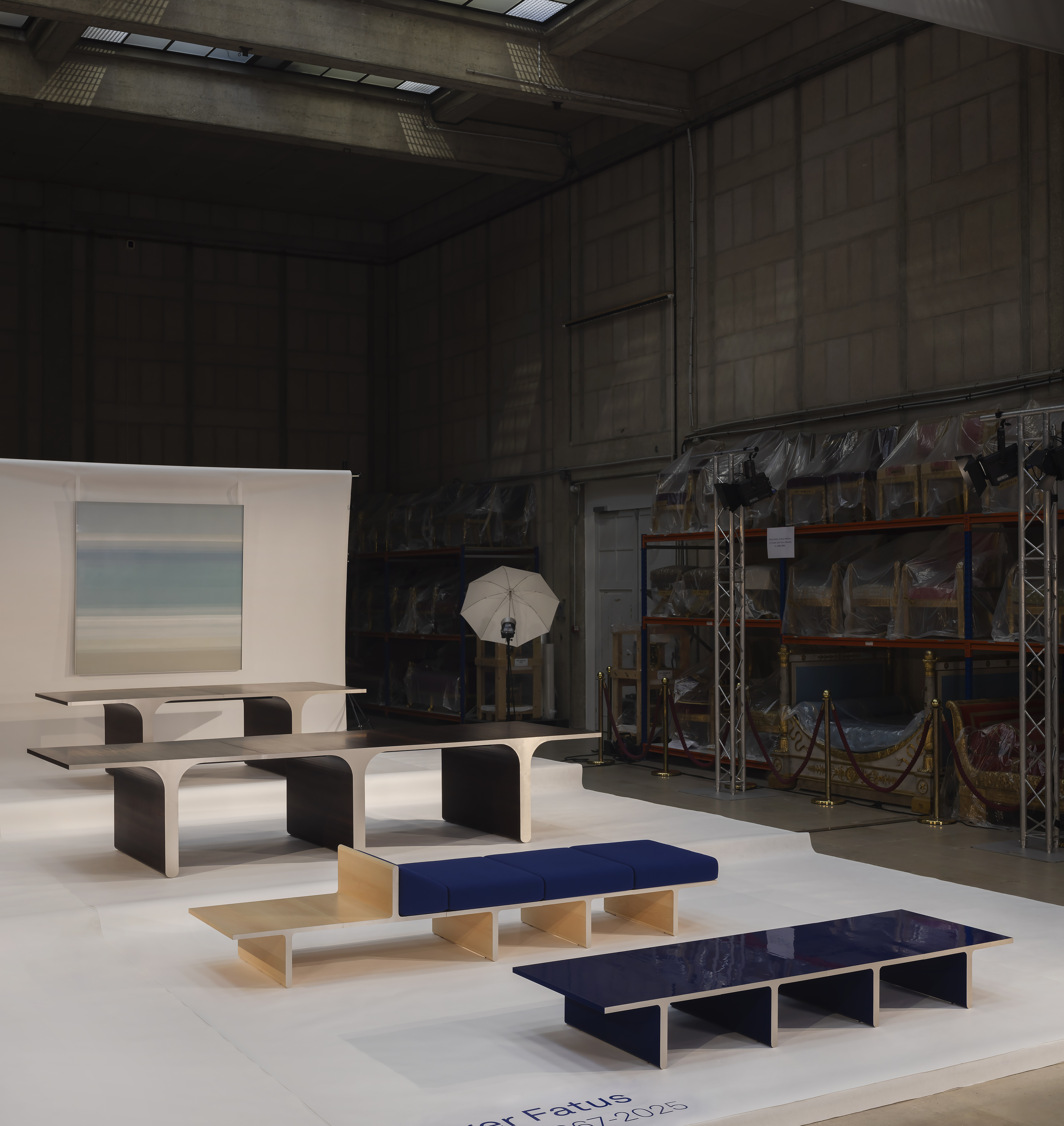
Launch of the Roger Fatus Collection at the Mobilier National's Grande Reserve Perret - September 30, 2025.
LUCILE MONTAGNE
For this commission, you were therefore a team of interior architects.
ROGER FATUS
There were four or five of us, not many, but there was no follow-up afterward. For me, it ended there, because I never found out what the others had been able to do.
I think we must also say that the French were not leading the way. In Germany, the Bauhaus is fundamental for the evolution of our professions worldwide. In my opinion, the Bauhaus is the main trunk of this whole generation.
In France, things were not very clear. Everyone created their own models without knowing what the others were doing, which is regrettable — we would certainly have benefited a lot from each other’s reactions. It is unfortunate that there was no meeting, no shared understanding of the spirit of what we were doing. No more than before the war, when the Union des Artistes Modernes took off on its own.
THOMAS HOCHET
This project is one of the rare State commissions you received. Did you find the project’s organization different from that of the editors?
ROGER FATUS
It was not very different, but the ARC team was extraordinary — truly incredible people. Technically, you could ask them for anything, and they would manage to do it.
LUCILE MONTAGNE
They produced from your drawings the table and chairs, of which the Mobilier national now preserves seven examples. Were you given guidelines, or was it open?
ROGER FATUS
It was open. As for the chairs, there was no work done to improve the prototype. The ARC had made about a dozen in stainless steel, but they wobbled. It was not really presentable, because the chair was complicated to make. It is a chair that would cost an astronomical price, in my opinion. It is a matter of form: it is complicated; it is not minimalist, as I try to be. In our generation, there were those who knew how to design seating, and those who did not…
THOMAS HOCHET
For the table, you imagined a modular system. Was modularity something you were exploring at the time, or was it a matter of adapting to space constraints in public institutions?
ROGER FATUS
I had designed conference rooms for companies. The main problem with that type of project is that you cannot freeze a room, an entire space, around one table. It is not the table that should define the space. So, you need a certain flexibility of use. That’s what many office furniture manufacturers were doing — the notion of modules was natural.
LUCILE MONTAGNE
Were you guided by the workshop when choosing materials?
ROGER FATUS
I offered this table in wengé, an exotic African wood, and stainless steel for the edges. At the agency, we discussed it: several of my collaborators, including Jean-Luc Noël, liked solid wengé but not veneer, which is more sensitive to light. Old wengé is not very pretty; it loses its color. Therefore, I decided to make something like a veneer but using solid wengé slats.
At the time, we were working with a stand manufacturer named Maillet, who worked extensively with architects. He had built a staircase for the City of Paris building at the Brussels International Exhibition in 1958, and he had used wengé slats for it. So, I thought it would look nicer that way, but it was not easy to do.
At the time, there were big companies like Uginox or the Boussois glassworks trying to break into our field. These companies financed much of the shows such as the SAD. Without these companies, we wouldn’t have been able to do it.
I witnessed the evolution of Formica sales. Back then, it had a bad reputation — it was for kitchens — yet they were making considerable efforts. They would invite us to their factory in the Pyrenees; one day there were two full train cars of architects going to the factory. It was very interesting; we witnessed new materials being born.
Once the conference table was drawn, I thought it wouldn’t be bad to make a coffee table for the conference room. So, I simply reused the idea, but this time it was no longer wooden slats; it was colored Formica.
THOMAS HOCHET
Were you satisfied with how the various exhibitions around these pieces of furniture were received?
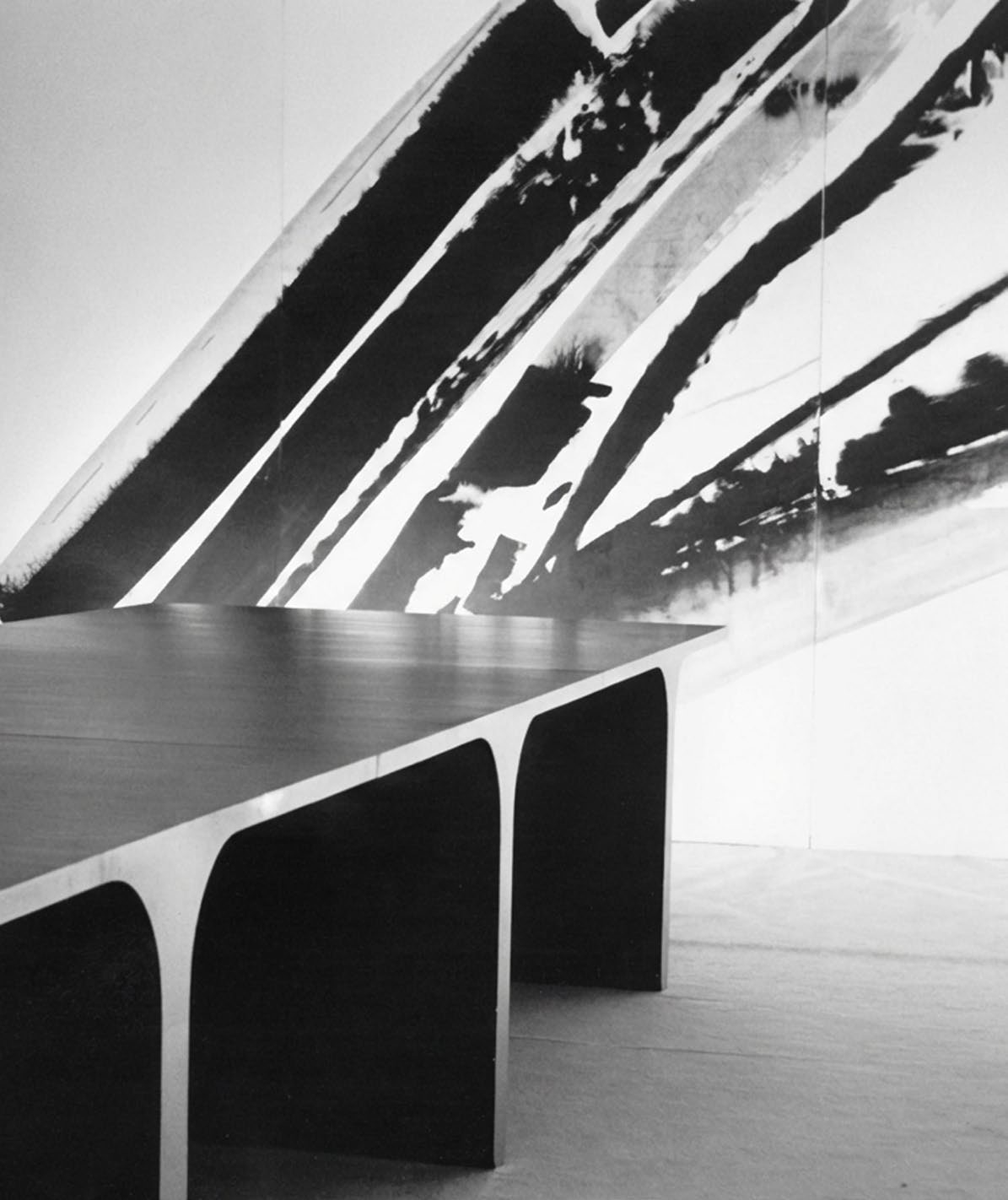
Roger Fatus presentation at the Salon des Artistes Décorateurs (SAD) 1967.
ROGER FATUS
My table was made just before the opening of the SAD fair at the Grand Palais in 1967. And the Mobilier national had offered me the chance to design my booth using the table. I contributed to designing the SAD fair and to presenting the works. It was already a minimalist booth with the table and chairs.
I was surprised because there were many reactions from friends and people interested in these models. They came to tell me it was fantastic. I remember telling Jean Coural that I didn’t understand. I had designed this table like a kitchen table for a private client. I didn’t see the difference; I didn’t see at all what was extraordinary about it. Sure, it was very interesting work, but for me it was part of the rest. Joseph-André Motte had also exhibited a stainless-steel desk in the same show, of which he was the president.
LUCILE MONTAGNE
Had you already exhibited at the SAD?
ROGER FATUS
I worked for several years with Jacques Dumond. He helped me a lot. He encouraged us to exhibit in the fairs. He was remarkable in that respect. He helped us get our start — Dirk Jan Rol, Janine Abraham, and me.
The first time I exhibited at the SAD, it was a child’s bedroom. A number of orphanages were equipped with the bed.
THOMAS HOCHET
Did you at the time wish to have these models produced?
ROGER FATUS
At the time, the idea of reproducing the table already existed. With Jean Coural, we met several companies, including one called Erbos, which mainly worked for the Navy in Nantes. They made tests and prototypes, trying to simplify things. But we never managed to finalize it.
It may not look like much, but it is a tabletop made of small slats, and the legs are clad in stainless steel. The stainless steel is glued to the edge of the tabletop and to the edge of the leg, and according to the ARC it was impossible to achieve a finish at the level the workshop wanted. This was done by machine, a kind of grinding wheel, but it was impossible to polish those stainless-steel elements by machine without tearing out the wooden slats. Stainless steel is an extremely hard material that requires very sophisticated tools.
They tried replacing it with aluminum, but it wasn’t great. They also tried metallic Formica, but that was even worse. Thus, we kept the idea, and it was up to the manufacturer to find the solution…
The Mobilier national also has a table, now placed at the Nanterre prefecture, acquired but not produced by the ARC, with a slightly different technique for the edges. From the table came the creation of a desk. There were no modules to assemble anymore; it was a single desk. I had also been approached by an architect, in agreement with the Mobilier national, who wanted to produce this desk for the administration of Gaz de France. That was done because it was simpler than the conference table, since it didn’t have the modular system.
This table was sold at Piasa: estimated between €20,000 and €30,000, it was auctioned for €138,000! The creations of that period sell very well on the market, just like those of Joseph-André Motte. I don’t know how to explain how such prices can be reached. At the time, we never thought about that at all.
I remember a conference given by Jean-Louis Berthet on that subject. I was stunned, because I had never once thought, while designing a piece of furniture, about what it might later become in the antique-dealer circuit. For me, furniture was for the present. But there were already people like Berthet who were thinking about it.
LUCILE MONTAGNE
It is interesting that there is so much enthusiasm for these creations, even if the prices do not always correspond to the intention of the creator, like the collective pieces of Jean Prouvé, which were meant for everyone. Are you surprised that the Mobilier national offered you a new project to reissue this model?
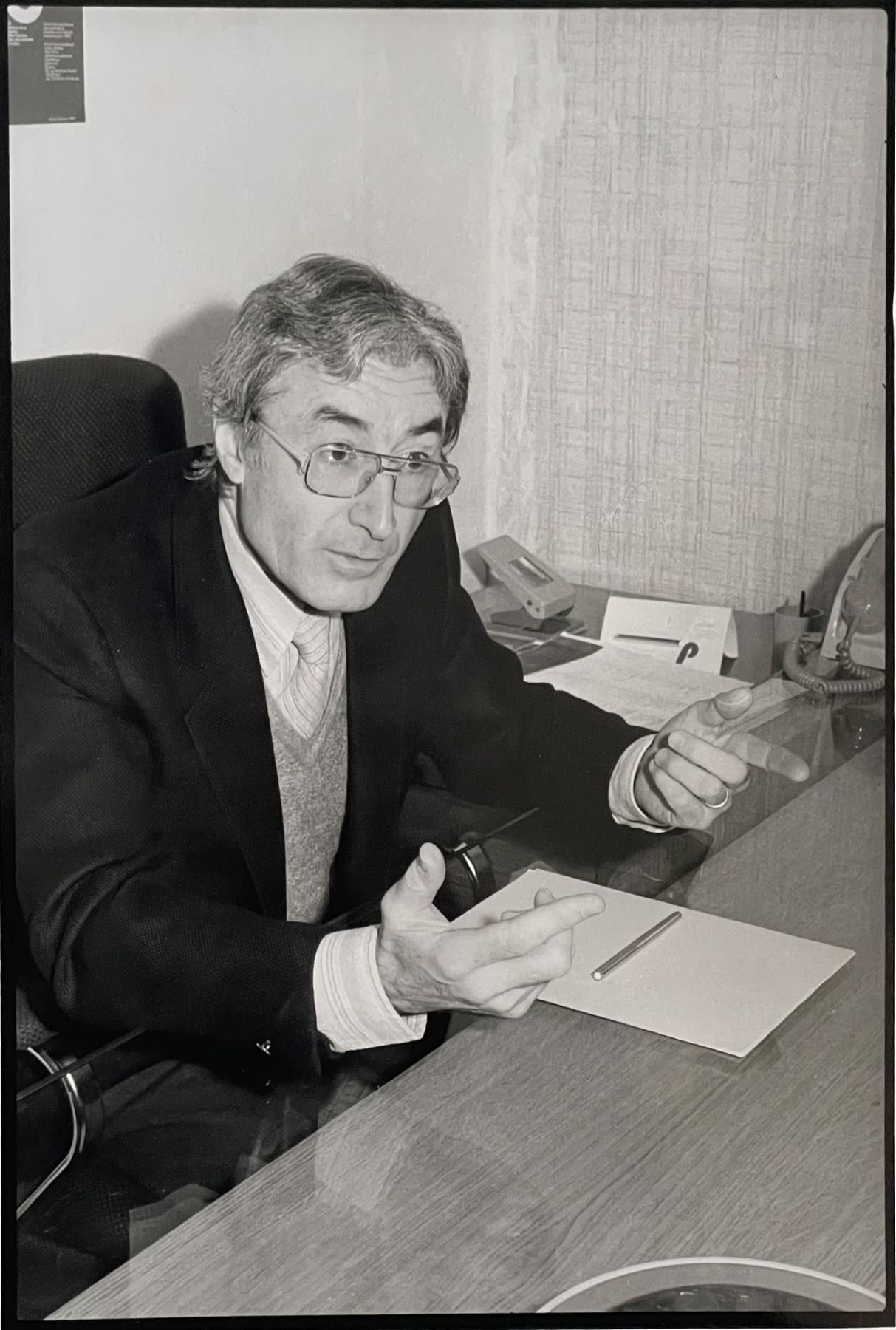
ROGER FATUS
It’s incredible that they would come offer me a contract after I turned ninety. I’m happy, but let’s not exaggerate. Designers are not at the center of events.
Later, I did a lot of teaching, and I was always surprised that students approached projects thinking they were going to become stars. Motte used to laugh, saying that young people would arrive at a company and ask where their office was. That attitude has grown now, if only with the specialized press.
THOMAS HOCHET
You said that the Mobilier national did not set the tone — do you think the institution is now more in step with its time?
ROGER FATUS
I’m surprised that there are so many acquisitions in the collections. There is research being done. But I wonder where exactly the Mobilier national positions itself.
I think now it is not a question of decoration. The term “decorator” always bothered us. You decorate something that is already made, but it is not décor that creates design. For me, interior design, as it is called today, is architecture. It is a play of space. The raw material of interior architecture is space. ▪