
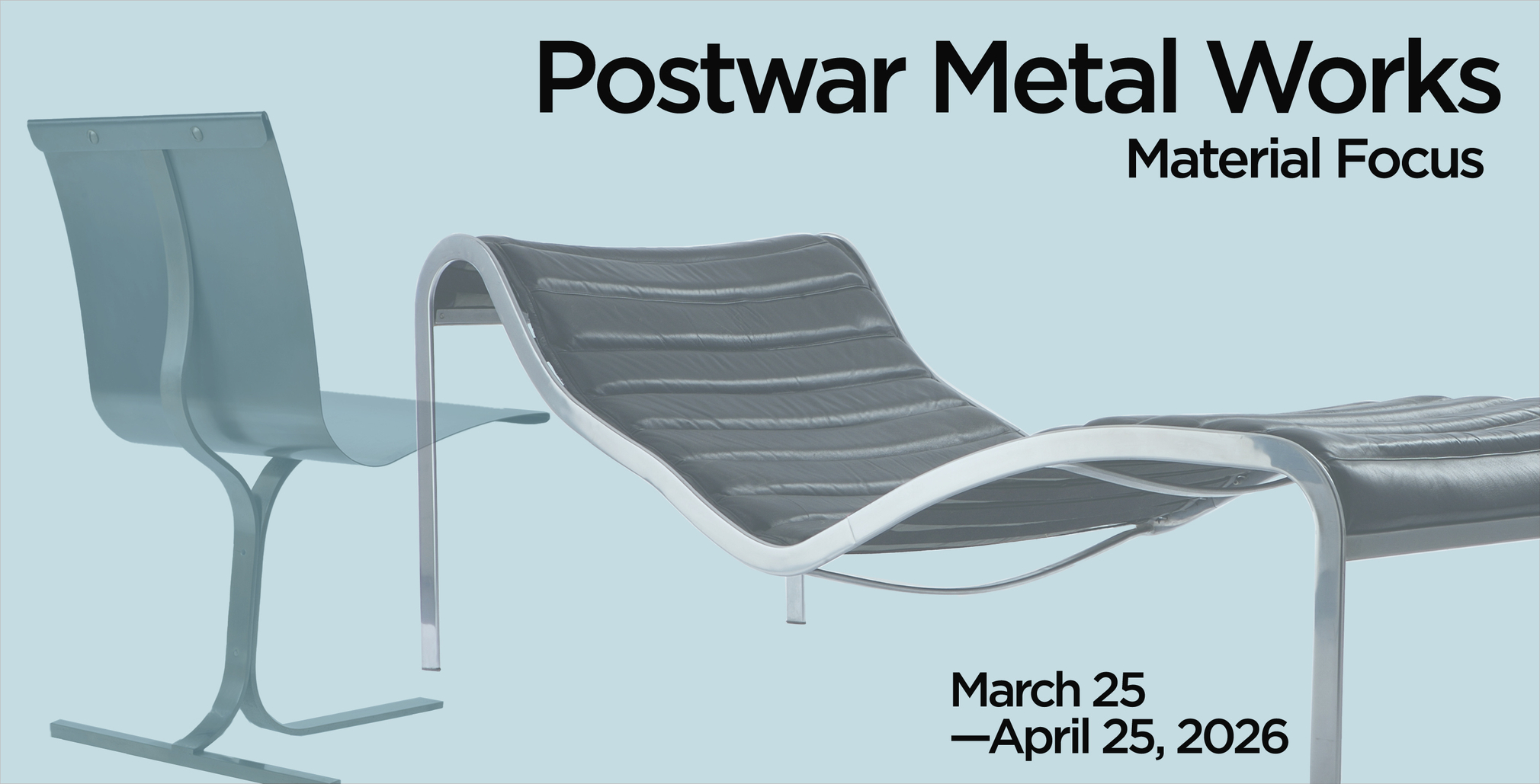


Postwar Metal Works
Material Focus
March 25 – April 25, 2026
In postwar France, modern industrial metals assumed a newly prominent place in the vocabulary of furniture and interiors. Metal was hardly new to the domestic environment—bronze, iron, and wrought iron had shaped furniture and interior settings for centuries—but the postwar period saw steel, aluminum, and stainless steel reimagined as refined and expressive materials for modern living.
By the 1950s and 1960s, designers were using steel, aluminum, and stainless steel with increasing assurance—not only for their structural clarity, but for their ability to register light, line, weight, and surface with unusual precision. These materials were valued not only for their technical and structural qualities, but increasingly for their aesthetic possibilities. It became part of a broader and more nuanced language of balance, capable of both restraint and sensuality.
This shift was closely tied to developments in the French metal industry, particularly the promotion of stainless steel by Uginox, the brand of Ugine-Gueugnon, France’s leading steel manufacturer. Although stainless steel had existed since the early twentieth century, it was long associated with industrial production, professional kitchens, and hygienic utility rather than domestic or decorative life. A decisive turning point came in 1967, when Gérard Martel of Ugine-Gueugnon began inviting designers to experiment freely with Uginox, encouraging them to treat stainless steel not as a technical material alone, but as a vehicle for form and invention. In doing so, he helped reposition industrial metal within the realm of high design.
No figure was more central to that transformation than Maria Pergay. Beginning in the late 1960s, Pergay revealed that stainless steel could be luminous, sculptural, and unexpectedly expressive. In works such as the Chaise Anneaux / Ring Chair, the Table Cocktail Carrée, and the Table de Salle à Manger, steel is bent, polished, and composed with a rare combination of exactitude and ease. Her forms are rigorous yet fluid, often reducing structure to a single continuous gesture. Even in later works such as the Totem Sconce, metal retains this dual quality: at once cool and tactile, architectural and intimate. Pergay did not merely adopt stainless steel; she changed its cultural meaning.
Around her, a wider generation of French designers was exploring metal in equally distinct ways. In the seating of Joseph-André Motte, Olivier Mourgue, Alain Richard, and Jacques Charpentier, chromed or painted structures provide clarity and tension while supporting soft upholstery, leather, or laminate surfaces. In lighting by Étienne Fermigier, Michel Boyer, Marc Held, and Roger Fatus, metal becomes an instrument of both control and atmosphere: a way to shape illumination through reflection, perforation, curvature, and finish. Elsewhere, in works such as Jean-Paul Barray and Kim Moltzer’s Hexagonal Console or François Arnal’s Z Chair, aluminum and chromed metal are pushed toward greater formal reduction, giving weight and volume a surprising sense of lightness.
The exhibition also emphasizes the proximity between design and sculpture in this period. César’s Expansion Bruxelles and the welded steel compositions of Albert Féraud show metal as unstable, dynamic, and openly expressive, testing the boundary between industrial process and artistic gesture. These works stand in productive dialogue with the furniture on view, where innovation often arises from similar acts of bending, welding, polishing, compressing, and assembling. In this context, metal is not simply a material category but a field of experimentation shared across disciplines.
Several works in the exhibition further trace how metal entered official and prestigious interiors, confirming its status within the language of modern French decor. Mourgue’s Montreal Low Table was commissioned by the Mobilier National for the French Pavilion at Expo 67 in Montreal; Raphaël’s lounge chairs were made for the Foyer des Parlementaires at the Assemblée Nationale in Paris; Marc Held’s Élysée Lamp was designed for President François Mitterrand’s private apartment at the Palais de l’Élysée. Such commissions show that metal, once marked by utility or experimentation, had by the late 1960s and 1970s become fully legible as a material of national representation, contemporary luxury, and institutional modernity.
Postwar Metal Works brings these threads together to show how French designers transformed the meaning of metal in the decades following the war. Whether brushed, chromed, perforated, welded, or mirror-polished, metal appears here not as a singular aesthetic, but as a rich and varied vocabulary. It could be structural or decorative, severe or sensual, industrial or luxurious. Across furniture, lighting, and sculpture, the works in this exhibition reveal a moment in which metal became one of the most expressive materials of postwar design.